As part of its consumer protection operational objective and Consumer Investment Strategy, the FCA is continuing its work on addressing the potential harm to consumers, with a recent consultation paper (CP22/2) focussing on how the financial promotions rules could be strengthened further.
Consumers can now access investments via online platforms easily and quickly. The FCA is concerned about consumers investing in high-risk investments that don’t match their appetite and tolerance for risk. This can lead to consumers suffering unexpected, significant losses.
The original discussion paper (DP21/1) followed the introduction of the FCA’s Investment Harms campaign and sought views on three areas where changes could be made – the classification of high-risk investments, the segmentation of the high-risk investment market and the responsibilities of firms that approve financial promotions. This consultation builds on those proposals.
Who will be impacted by these proposals?
- Firms which issue financial promotions to, or likely to be received by, retail clients
- Firms which approve financial promotions for other entities
What will be changing?
The FCA, in this consultation paper, is proposing changes in the following areas:
1. Classification of high-risk investments
Under its proposals, the FCA seeks to rationalise the rules for high-risk investments to ensure products with similar characteristics are treated similarly. There are currently multiple rules across different product categories such as ‘non-mainstream pooled investments’ (NMPIs), ‘non-readily realisable securities (NRRS) and Speculative Illiquid Securities (SISs). This has created some confusion with market participants. Consequently, there will now be three product categories and accompanying marketing restrictions:
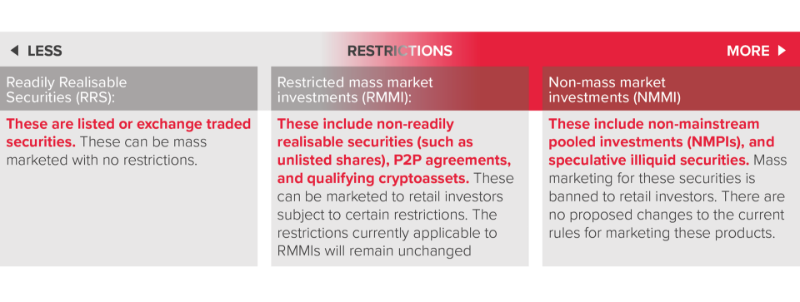
2. The consumer journey into high-risk investments
To ensure that consumers are not just clicking through without understanding the risks involved, the FCA is proposing the following changes:
- A new risk warning statement when marketing RMMIs and NMMIs. These must be prominent and include a link to an expanded, product-specific risk description.
- Inducements to invest will be banned. These include refer a friend or new joiner bonuses.
- Positive frictions will be introduced into the customer journey to counter social and emotional pressures to invest. Under the FCA’s proposals, firms will be required to provide a personalised pop-up for first time investors when signing up to invest in RMMIs and NMMIs. A 24-hour cooling off period will also apply to these first-time investors.
- Investor declaration forms will be changed to require investors to state why they meet any of the high net worth, sophisticated or restricted investor criteria. They would also now have a ‘none of the above’ option.
- Appropriateness tests will be strengthened when marketing RMMIs to ensure that consumers only invest after a robust assessment of their knowledge and experience has been carried out. These include strengthening the questions posed to investors as part of the assessment, introducing a 24-hour cooling off period between test retakes, including asking different questions each time.
- Firms will also be required to maintain adequate records that show the impact of these proposals, including data on whether customers proceed to access the investment after each intervention, whether they click the link in the risk warnings and the outcomes of the client categorisation and appropriateness assessment.
- Firms that allow consumers to invest in high-risk investments via debt-based payment options, for example, credit cards, will be required to consider whether they have adequate systems and controls to monitor for indicators of vulnerability, such as over-indebtedness.
3. Strengthening the role of firms approving and communicating financial promotions
As part of its proposals, the FCA seeks to:
- Introduce new guidance to enhance the clarity of the obligation for approvers of financial promotions to include their name in those promotions. In addition, new rules will require the promotions to include a date stamp to make clear when the promotion was approved, which will enable the consumer to consider its relevance and prevent them relying on outdated information.
- Introduce a new rule requiring firms to self-assess whether they have the necessary competence and expertise (C&E) in an investment product or service before approving or communicating a relevant financial promotion. This rule will apply to firms approving promotions for ARs, intra-group businesses or third-party unauthorised firms, as well as firms issuing their own promotions. There are currently no proposals to include a prescribed responsibility under SMCR for the C&E requirement but will be reviewed in the future.
- Strengthen the obligation on approvers of financial promotions for the ongoing monitoring of financial promotions to ensure they remain compliant with the rules on ‘fair, clear and not misleading’. They will also be required to receive quarterly attestations of ‘no material changes’ from their clients, and for the lifetime of the promotion.
- Extend the rules on conflicts of interest to ensure approvers of financial promotions do not engage in anti-competitive market practices.
- Introduce a new requirement for approvers of financial promotions to periodically check the compliance of appropriateness tests used by the firms for whom the promotions are approved.
4. Applying the financial promotion rules to qualifying cryptoassets
Following the Treasury’s confirmation that it is extending the scope of financial promotions to include cryptoassets, the FCA is proposing to include qualifying cryptoassets in the definition of RMMIs. Qualifying cryptoassets are defined as “cryptographically secured digital representations of value or contractual rights which are fungible and transferable”. The rules applicable to qualifying cryptoassets will also apply to instruments which provide rights to or interests in qualifying cryptoassets, even when those instruments are themselves not controlled investments.
What should firms be doing?
While the consultation is in progress, no action is required but firms should begin to consider how the proposed new rules will affect their financial promotions processes.
This could include any combination of the following (but not limited to):
- An initial gap analysis between current processes and the proposed new rules;
- Updating policies and procedures, including controls around marketing processes and record keeping;
- Reviewing the governance, MI and record keeping requirements for the approval of financial promotions; and
- Considering the competence requirements for those involved in the financial promotions approval process
- Setting up new data collection processes to measure consumer behaviour in response to the proposed changes
Firms that market RMMIs and NMMIs to retail investors will be most impacted by these rules with proposed changes likely to have an impact on sales and onboarding processes.
Next Steps
The deadline for response to the consultation questions is 23 March 2022, with final rules due in the summer.
Once final rules are published, firms will have three months to comply with the new requirements for the consumer journey and financial promotion approvers. Cryptoasset requirements will apply from the date cryptoassets are brought within the financial promotions’ regime by the Treasury.
If you would like to discuss how the proposals could impact your business or understand how BDO can support you in future proofing your financial promotions processes, don’t hesitate to contact Richard Barnwell
Subscribe to receive the latest BDO News and Insights
Please fill out the following form to access the download.